Everything you wanted to know about abseiling but didn't dare ask
by Bob Wightman Jun/2006
This article has been read 58,764 times
Related UKC Articles and Gear Reviews:
Related UKC News items:
Related UKC Forum discussions:
 
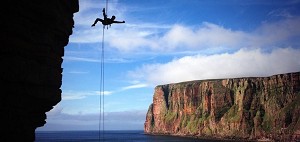
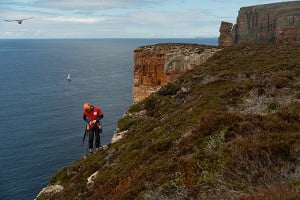
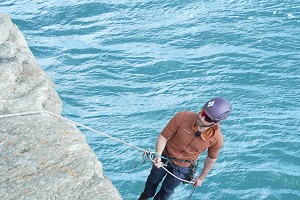
Abseiling from the In Pinn © jez s, Jun 2005
Abseiling Tips
Abseil is a word of German origin and rhymes with style not sail.
They chose the French term for sliding down a rope whereas we chose the German.
Nothing more to it than that.

Abseiling the Bergshrund, Mt Blanc du Tacul © Dan Arkle, Apr 2007
Abseiling is one of those activities that appears to be enjoyed by those who do not know
of its risks. Consequently, most non-climbers like it whereas most climbers do not.
The reason for this is probably because most non-climbers have never done an abseil under
anything but tightly controlled conditions. One abseil under normal conditions would
convince them otherwise!
So why do most climbers have a dislike for abseiling? Basically it is down to two things:
- single system with no backup.
- Easy to get wrong.
However with a little thought many of the risks may be reduced, though not entirely
removed.
If you are just going to be abseiling less than half a rope length then any rope
will do as you simply take the middle of the rope and attach to the belay point then
lower or drop the two ends.
If the abseil is longer (up to a rope length) then you will need two ropes. The
only restriction here is that both ropes should be the same diameter. Using an 11mm
rope with an 8.5mm rope will lead to problems as the two ropes will interact with the
abseil device differently with the thicker rope having more friction and passing through
the device more slowly. A slight difference in diameter (9mm & 8.5mm) is nothing to
worry about.
There is much discussion as to which knot is best to use to join the two ropes together and
over the years thoughts have changed.
The table below summarises the various knots that are in common use for tying two
ropes together for abseiling. One point to note is that for all the knots, the “tails”
should be at least 30cm in length to allow for slippage and tightening of the knot.
| Knot | Difficulty | Notes |
| Double Fishermans | Easy to get wrong. |
This is the knot by which to judge all others. If tied correctly, it is
the strongest knot available for this purpose. If your ropes are of different
diameters then it is the only knot to consider. It does have some major
drawbacks though: it is very difficult to undo after being loaded; it is
also symmetrical meaning that it is likely to snag easily.
|
| Figure of Eight |
Not as easy as is imagined.
|
To tie the figure of eight correctly requires that both ropes travel a particular
path through the knot. This is very difficult to ensure in a stressful situation.
In addition to this, the knot has an alarming tendency to roll along the rope
when stressed at right angles to its main axis. Not recommended
|
| Overhand |
Fairly easy. |
At first the overhand knot looks as if it would be weaker than the figure of eight
but in fact it is both stronger and more resilient to pulls across its axis
|
|
Reef
|
Simple and easy
|
The reef knot (square knot) is very simple to tie but, like the double fishermans,
is a symmetrical knot so suffers from the same problems of being prone to catch.
It is a very poor knot to use for ropes of different diameters. Perhaps
its best use is in the centre of a double fishermans knot, using the latter as a
safety backup.
|
It depends on the situation. But current thinking/best practice indicates one
of the following.
The double fishermans. Or, a reef knot backed up by double fishermans.
When: Your ropes are of different diameters; You absolutely have to be sure.
Overhand knot
When: the face down which you are abseiling is featured and you do not want to
chance getting the rope stuck. Most abseils.
See this article at Needlesports
for more info on knots for abseiling.
Basically any anchor that is good enough to belay from. Unless you are abseiling
from a permament abseil station it is likely that you will have to sacrifice some
of your own equipment to make the anchor. Usually this is no more than a couple of
wires or a length of sling or cord to replace existing loops (where the condition of the existing loops may have been
affected by the elements or excessive use).
Certainly not! Commando style is all well and good when you have solid anchors and
an easily impressed audience. Out in the hills it is a different matter and you
should aim to stress the system - particularly the anchor as little as possible.
Most stress on the anchor occurs in the first few metres of the abseil so it is
at this point that you should be as smooth as possible, creeping over the edge whilst
making sure that the ropes do not run over any sharp edges and that they have not
snagged beneath you. Keep your feet apart for stability and walk down the rock as
smoothly as you can.

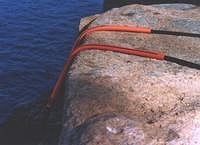
Rope Protector © Gear Express, May 2007
The best way is to use something like an empty rucksack to pad the edge. A piece
of karrimat would work just as well or purchase one of the many commercially made rope protectors (see photo) Attach to the rope that you are going to pull
when retrieving the ropes with a prussic. This avoids it working over the edge. The
second person can adjust its position whilst the first is abseiling.

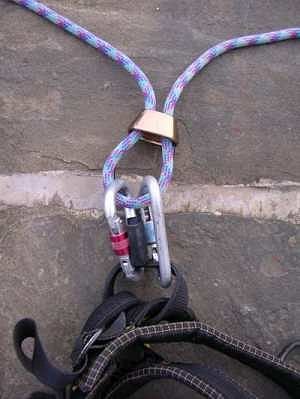
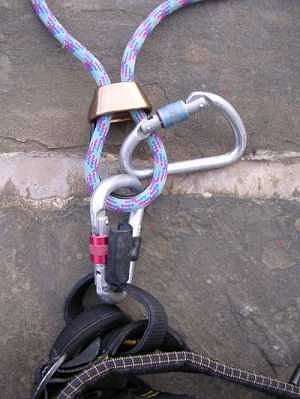
How to clip a krab to increase friction © Bob Wightman, Jan 2006
In order to increase the friction all that is required is a second karabiner, preferably a
screw-gate. With the rope(s) threaded through the device and the main karabiner take this second krab and clip it
into both the bight of rope and the harness attachment point, thereby doubling up the main krab. This has the
effect of forcing the rope through tighter curves as it passes through the system which increases the friction.
Note that the gate of the second karabiner is facing the opposite way to the main krab even though they are both screwgates.

How to clip a krab to decrease friction © Bob Wightman, Jan 2006
To decrease friction, again take a second karabiner but this time clip
it into only the bight of rope passing through the device. It must be
positioned so that it lies between the back of the device and the main krab.
This has the effect of allowing the rope to pass through less severe curves as
it passes through the system.
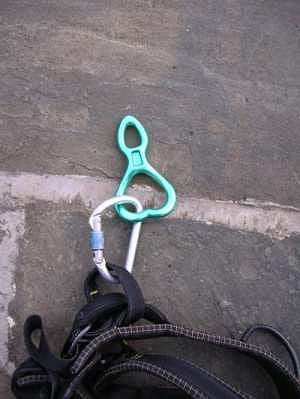
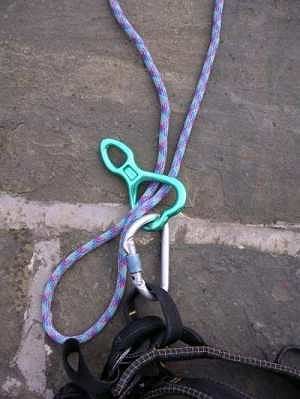
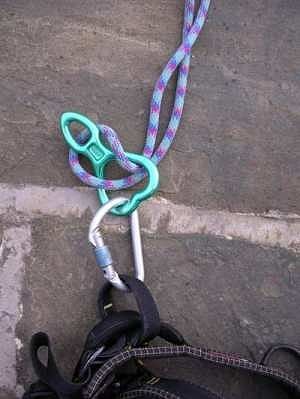
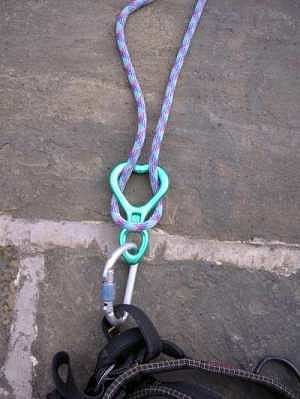
There is a simple way to do this. Keep the Figure of Eight device clipped via the
large hole. When you come to use it, pull a bight of rope through the large hole
as you normally would and pass it round the back of the smaller hole, again as normal.
The device is now trapped by the weight of the rope so you can unclip from the larger
hole and into the small hole ready for use.
To remove, simply reverse the above procedure.

Have the figure of 8 clipped via the large hole. © Bob Wightman, Jan 2006

Take a bight of rope and without unclipping the Figure of Eight pull it through the large hole. © Bob Wightman, Jan 2006

Now pass it round the stem of the device. © Bob Wightman, Jan 2006

Take the device out of the krab and turn it round so that you can clip into the small hole. © Bob Wightman, Jan 2006
Tie a knot in the end of each rope to prevent you from sliding off the end.
You need one on each rope as just doing it on one rope could cause the system
to pull through the belay. This also helps find the end of the rope in those
instances when they get caught after being thrown down, either because of wind
or because the rock is heavily featured. In order to help remember which rope
needs to be pulled at the next stance (or ground) - clip a krab into the end
knot of that rope.
Clip a quickdraw between your harness and onto the rope in question. This
also has the benefit of keeping the ropes separated when you come to pull them.
Given that in most situations you are totally reliant on the anchor and the
ropes and that there is little you can do to back these up, the only other weakness
in the system is yourself.
If there is a chance of debris falling on you then it is beneficial to use a French Prussik
or Klemheist knot around both ropes. Whether this knot is above or below the abseil device is down
to personal preference - I have seen valid arguments for both - my personal preference is to have the
knot above the device.
There are rare occasions when you need to abseil a full rope length but only
have one good rope available. For example: The other rope has been damaged in
some way and you do not want to trust it. Another scenario is if you are climbing
lightweight on a single 9mm rope and have brought along something like a length
of 6mm cord for emergencies. So how do you make a full 50m abseil?
- Start by passing the good rope through the belay then joining the ropes with either a double
fisherman's knot or a reef knot backed up by a double fisherman's.
- Tie a figure of eight on the bight or an alpine butterfly knot into the good rope next to the double
fishermans, and clip a screwgate krab into it.
- Clip the krab back onto the good rope.
- Now abseil on the good rope, the krab effectively ties the rope to the belay when tensioned from this side.
- At the end of the abseil, pull on the unused rope. The ropes will pull as normal.
|