

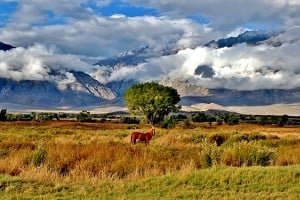
Looking up at the rolling hills that lie on the north side of Glen Spean above Loch Laggan you could be forgiven for thinking that they hold little of interest to climbers compared with the mountains of Lochaber to the west and the Cairngorms to the east.
From the perspective of the summer rock-climber this is certainly true, but for those who seek adventure in the winter months these hills conceal one of the greatest winter climbing venues in Scotland, the huge cliffs of Creag Meagaidh, Coire Ardair.

© highaltitudebarista, Mar 2013
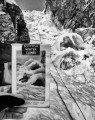
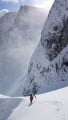
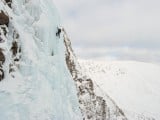
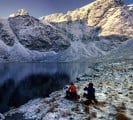
Coire Ardair is in some ways the 'perfect design' for Scottish Winter climbing. Facing East through to North, the great cliffs are tucked into the cold of the shade for much of the winter. Above them, the rolling summit plateau stretches to the west allowing westerly storms to pour snow down the cliff-faces. The shattered schist of the cliffs has an inward-dipping horizontal strata supporting a jungle of turf that catches and holds the snow, and the plateau is drained by huge gullies that cut vertically through the full height of the cliffs - forming the great ice-lines for which the mountain is famous.

© IainMunro, Apr 2010
A bit of History
The history of climbing on Creag Meagaidh reads like a who's who of Scottish Winter climbing. On either side of the turn of the 20th Century, the omnipresent Raeburn made the initial winter forays tackling the two huge gullies that lie either side of Pinnacle Buttress: Easy Gully (I) and Raeburns gully (VD) . Bell and partners began the exploration of the steeper gully lines on the faces in the 1930's but the mountain's heyday came with the great step-cutting talents of the 1950's and 60's. Fierce competition between among others Marshall, Smith and Patey with some provocative route-naming and traditional Whillan's putdowns thrown in for good measure saw most of the obvious ice lines quickly conquered.
"....the mountain's heyday came with the great step-cutting talents of the 1950's and 60's."
Fast forward to February 1983, and the competition continued, with Fowler and Saunders 'winning' the walk-in race against Nisbet and Harper (though they actually had a different target) to make the first ascent of the impressive The Fly Direct (VII 6) - a route that remains one of Scotland's hardest and most sought after ice-climbs. Exploration continues today, now focusing on the steep vegetated walls between the gullies on Pinnacle Buttress, with the likes of Heselden, Tresidder, Robertson, Moran and MacPherson plus some 'imported' talent leading the charge.

© Al Todd, Mar 2011
The Cliff and the Climbs
Rising above the Lochan a' Choire in the base of the coire, the cliffs of Coire Ardair are separated into five main sections. From south to north, the first section of cliffs (Bellevue Buttress and Raeburn's Gully buttress) are somewhat overshadowed by their bigger brethren.
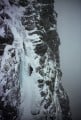
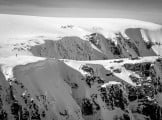
Towering above Raeburns gully (VD) (I), Pinnacle buttress stands almost 500m high making it one of the biggest mountain cliffs in Britain. It's left-hand side is split by vertical gullies and grooves taken by the classic ice-lines of No match for climb id:"Ritchie's Gully" (IV), No match for climb id:"Smith's Gully" (V), The Fly Direct (VII 6) (VII) and The Midge (VI 5) (VI). It's right hand side is more broken, with the superb 1959 Face Route (V 4) (V or VI) taking the most obvious line.
 © Jonny Tee 69, Mar 2010
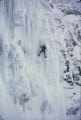
The top of Pinnacle Buttress merges into Easy Gully (I) (I), above which rises the left-hand side of the Post Face, named after the vertical 'Post' gullies that drain the plateau above. These form four of Scotland's most classic ice-routes, Last Post (V 5) (V), South Post (III) (V) Centre Post (III) (III or V) and North Post (V 5) (V). Beyond, Great Buttress looms high above the coire floor, split by the deep gullies of the pipes - Staghorn Gully (III) (III) and South Pipe Direct (IV 4) (IV).
The cliffs now turn northwards, rising above the south side of 'the Window', a vast open gash giving the easiest route between the coire floor and the plateau. Known as the Inner Coire, the climbs here include Trespasser Buttress (IV 5) (IV) - the best mid-grade mixed route on the mountain and a good back-up option, and the much sought after classic ice-lines of The Pumpkin (V 4) (V), the The Wand (V 5) (V) and Diadem (IV 4) (IV).
Conditions, conditions, conditions:
Tucked away from inquisitive eyes, and off the regular beat of instructors and guides, information on Creag Meagaidh is much harder to come by than with more popular venues. That said, once word filters out that the 'ice is in' the mountain rapidly proves very popular.
As always, making predictions about conditions in Scotland is very much crystal ball territory, however there are some general guidelines for Creag Meagaidh. The height of the cliffs makes the cliff-base comparatively low (around 850m) and the turfy faces take time to freeze, so a sustained period of cold is required to bring the cliffs into condition. The gullies can form from drainage, but a build up of snow helps so the later part of the winter (February and March) is more likely to see decent conditions. Thaws can rapidly destroy the initial pitches of routes and Meagaidh is not regarded as a reliable 'there'll be something to do' venue like Ben Nevis or the Northern Corries.
Most importantly, the layout of the Coire makes it a MAJOR AVALANCHE VENUE, with potential areas of windslab and possible large cornices threatening many routes and the base of the coire. The Scottish Avalanche Information Service www.sais.gov.uk monitor Creag Meagaidh throughout the winter (with a daily 5hr round trip in all weathers!) so are the best source of up to date information.
Logistics
When to Go
Conditions are difficult to predict (see above) but later in the winter season is normally the best time to think about making a trip. Creag Meagaidh is realtively low in elevation and thaws quickly. It is also prone to avalanche and cornice collapse (see above).
How to Get There
A car is pretty much essential for getting to Creag Meagaidh. The approach begins from the car-park off the A86 at Aberarder Farm (don't block access). The infamous railway sleeper path has now been replaced with a good walking track above the north side of the Allt Coire Ardair which it follows to the base of the cliffs taking around 2-2.5 hours provided the trail breaking isn't too bad.
Guidebook
The best guidebooks to the climbing on Creag Meagaidh are the SMC Ben Nevis guide, and the SMC Scottish Winter Climbs guide. Of these, the latter is probably best for the first time visitor as it has excellent clear photo-topos.
Instructor/Guides Advertise here
No Premier Listings found in this area
Gear
Creag Meagaidh is principally an ice venue so a decent rack of screws is very helpful, and the turfy and compact nature of the rock can make a hook and a few pegs handy as well. Many pitches are long by Scottish standards so 60m ropes can make life a bit easier. Lastly, the plateau is notoriously tricky to navigate off in bad weather/darkness so maps and compasses at the ready!
Outdoor Shops Advertise here
No Premier Listings found in this area
Accommodation Advertise here
No Premier Listings found in this area
Accommodation in the immediate area is very limited to say the least, and most parties will chose to base themselves west - Tulloch Station and Fersit are closest, but Roybridge, Spean Bridge and Fort William are easily doable, or east - in Laggan, Newtonmore, Kingussie or Aviemore.
Food and Supplies
Fort William is the nearest large town with plenty of gear and food shops.
Other Activities
Aside from climbing, Creag Meagaidh is also a well known venue for ski-touring as the area holds snow well and its plateau and slopes are less rocky than many other areas. Ski Mountaineering in Scotland www.smc.org.uk details possible tours.
Climbing Walls Advertise here
No Premier Listings found in this area

© Viv Scott

About Viv Scott
Growing up in London, Viv moved to Scotland for university seven years ago where he continues his apprenticeship in the bizarre world of Scottish winter climbing with many repeats and the odd new route. Further afield, Viv has made regular visits to the Alps and has been on a couple of trips to the Alaska Range, climbing the classic North Buttress of Mount Hunter with Tony Stone and Steve Fortune in May 2009. Despite his focus on wintry things, he probably most enjoys a cold beer after a days cragging in the sun.
UKC Articles and Gear Reviews by vscott
- REVIEW: Mountain Hardwear Mixaction and Seraction Jackets 16 Dec, 2014
- Lochnagar - Winter Destination Guide 17 Nov, 2014
- REVIEW: Petzl Sirocco Climbing Helmet 4 Aug, 2014
- REVIEW: Patagonia Adze Jacket 17 Jun, 2014
- Blue Ice Warthog 38 Rucksack 21 Aug, 2013
- Petzl Lynx and Black Diamond Stinger Crampons 6 Mar, 2013
- Marmot Ama Dablam Jacket 14 Dec, 2012
- Sea To Summit Micro McII Sleeping Bag 8 Nov, 2012
- Black Diamond Ultra Distance Trekking Poles 16 May, 2012
- Mammut Eiger Extreme Nordwand TL Boots 19 Feb, 2012




Comments