


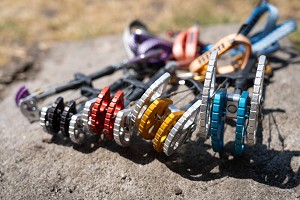
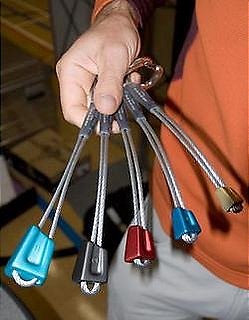
© UKC Gear

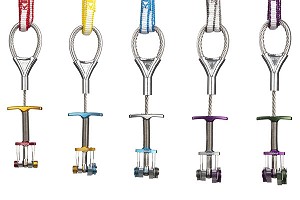
I presumed this was simply going to be a love song, to sing the praises of the perfect piece of gear, but it is not. As a reviewer this is good, because it's hard to say something is perfect in an interesting way. So, the much awaited DMM Alloy Offsets, good, but in their current form far from perfect (see STOP PRESS at the end of this review).
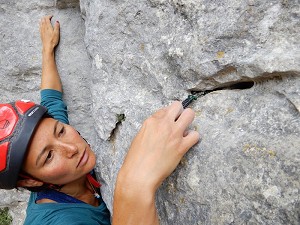
A little history first: I bought my first HB Offset in I think 1991 – mainly because I didn't know any better. It was a nut, on sale, in the only climbing shop I knew at the time, so I bought it. I didn't know that nuts aren't meant to be offset – that most wired nuts presume that cracks are the same width at the back of the placement as at the front. It is fortunate that I didn't know this, because it isn't true. Lots of cracks are flared – wider at the opening than deeper into the crack. Indeed once you get used to having Offset nuts on your rack, you seem to notice that as many cracks are flared as not, because now you have a good chance of getting gear to sit in them. Having bought one HB nut, I subsequently bought the other sizes around it, and with these backing up my 1-9 DMM Wallnuts I was ready for adventures into the non-parallel world. My four HB Offsets became over the next decade my favourite pieces of gear, fitting everywhere from the wiggly schist of the Arrochar Alps, via the piton scars of Millstone to the finger-crack perfection of Lofoten granite.
One got claimed by the mountain during a pretty full-on ascent of the Shelf Route (IV,6) on Buchaille Etive Mor, and another got dropped into the inky depths of a Finnish lake from a route above – but replacements were found in the few shops far-sighted enough to stock them. The Offsets were never very popular, being perceived as overly “specialist” – in part seemingly due to their popularity with Yosemite aid climbers, had a minor renaissance this decade when Andy Kirkpatrick lauded them in his magazine column, but when HB went bankrupt it seemed that the Offsets would be no more. Hence it was with real pleasure that offset-lovers heard that DMM had bought the moulds and would bring the offsets back to market.
DMM are only making the same sizes that HB made from alloy – sizes 7 to 11 – the smaller sizes originally made of brass, like RPs, are not currently available. The limited range means that the Offsets are a useful addition to a standard set of nuts, not a replacement to them.
DMM rightly realised that the shape was good already so have made no changes to the
fundamental design of the nuts, but they have added some features. Firstly they are now
anodised to aid in picking the right size and the anodising is in colours that correspond to
the Wallnuts of the same size. Having used non-anodised nuts for 15 years before getting
coloured ones, I'm unconvinced of how useful this really is, but perhaps to those climbers
who have always had this feature it is second nature – if nothing else it makes the gear look
really smart and the more scratched off the anodising is from your nuts, clearly the more
hardcore you are! They have also drilled some lightening holes in the bigger nuts – a tiny
difference of course, but it all adds up across a rack. Finally, and this is where the moaning
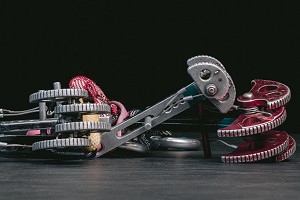
starts, they have countersunk the holes on the top, forming a smooth arch that wire runs
across, meaning that the wire is very neatly recessed into the top of the nut, but also as far
as I can see causing a major problem in how the offsets function. 
This problem is the great ease with which the head of the nut slips down the wire. This is very noticeable even before you start climbing, in that by the time you drag your bunch of wires out of the depths of your rucksack you'll already notice that the heads of the Offsets have slipped down their wires. For the leader this isn't a great problem, you can pull the head of the nut up to top the top of the wire with your teeth if necessary, but for the second it is a huge hassle. Until I tried retrieving the new DMM Offsets, I don't think I realised just how much you rely on the head of nuts NOT slipping down the wire when getting them out: in effect you are pushing up on the wire, to push the nut out of its placement. If, as with the Offsets, when you push on the wire the wire simply just slides up through the head of the nut, you simply can't remove the nut without resorting to a nut key. Of course with all nuts sooner or later you jam them in hard enough that a nut key is needed for retrieval, but with the Offsets it is basically every placement you make. On a short single pitch crag this is just mildly annoying, but on a lengthy mountain route, every couple of minutes the second spends wrestling with uncooperative gear is two minutes wasted and will soon add up to something more serious if you are placing the same gear pitch after pitch. For that reason I would not recommend DMM Offsets currently if your plans involve serious mountain routes, they are just too much hassle to use in their current form.
DMM told me that gauge of wire they use and the diameter of holes in the nut through which it runs on the Offsets is exactly the same as on their Wallnuts. But the DMM Wallnuts do not have this flaw. Therefore I think that it has to be the smooth arc of the recessed wire that is causing this problem - the lack of any sharp angles means there is very little friction between the alloy nut and wire. So unlike with Wallnuts, the head of the Offsets slides so easily. I am planning, after checking with DMM with regard to safety, to try and glue the head of the nut in place at the end of the wire. If I can find some way to do this, and hopefully if DMM can stop the slippage in future batches, then my opinion will go back to Offsets being amongst the best nuts around but not, sadly, until then.
STOP PRESS: And DMM have delivered
FROM Simon Marsh at DMM 24th June 2008.
 © UKC News
 © TobyA
The size of the holes has been reduced from 3.7mm to 3.5mm .
This will still allow climbers to move the head of the nut down the wire in order to loop the wire over bolt studs or protuding pegs, but should stop any accidental movement of the head on the wire when stripping the nut from placements.
A permanent solution is to araldite the head into place, although this reduces the versatility of the nut. "
More on DMM Alloy Offsets: www.dmmclimbing.com




Comments