

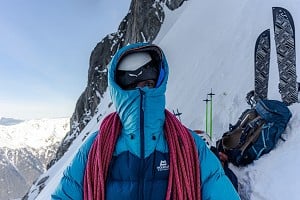
Despite the best efforts of chemists, synthetic insulation still can't match down for insulation performance, so when the temperature is well below freezing then down-filled clothing really comes into its own, says Viv Scott. Marmot started out making down equipment, and their experience shows in the design of the Greenland jacket. Hiding behind the slightly retro two-tone styling is a brilliantly made and seriously warm piece of kit.
 © Viv Scott Collection
"...when hiding away in the huge fixed hood my head could even claim to be warm, which is more than can be said for my feet..."
The 800 fill power down, combined with the baffled construction of the Greenland jacket, gives a huge amount of loft and a Michelin-man like feeling of impregnability from the cold. Ice climbing in -20 in the Lavangen area of arctic Norway is a cold experience, but the Greenland jacket did a superb job of making belay duty bearable.
Everything on the jacket has been designed for use in serious cold - the big chunky zip is easy to use with mitts, internal pockets keep water and gloves warm, fleece-lined hand pockets provide a retreat for frozen digits, and when hiding away in the huge fixed hood my head could even claim to be warm, which is more than can be said for my feet...
Marmot's Curly explains what's good about Marmot down in their Down Testing Room:
Missing video!
The Greenland jacket is probably overkill (though luxurious) for general UK use, but well worth it if heading to the cold of the arctic, Alaska, the Alps in winter, not to mention Greenland... or anywhere else where you expect temperatures well below freezing. Top quality down gear is not cheap, but it's worth every penny in the cold, and if looked after will last for decades.
 © Viv Scott Collection
How do you tell if a down jacket is well constructed?
To trap air, down has to be held around the body by the clothing. This is done by separating the garment into lots of down filled compartments to keep the down in place. The simplest (and cheapest) way to do this is to 'stitch through' between the outer and inner fabrics, trapping the down in compartments with an oval cross section, but this means that along the stitching there is no down between you and the cold.
More complex (and more expensive) is baffled construction, like the Greenland jacket, where additional strips of fabric join the outer and inner fabrics so that each compartment has a rectangular cross section. This means that the down is more evenly spread, so traps your body heat better and keeps you warmer.
Down fill explained:
The warmth of down clothing depends on two factors. First, the down itself - how much of it there is and its ability to loft and trap air. Second, the design of the garment - how it holds the down in place around the body to trap air.
Down quality is measured in fill power - essentially how much air a given weight of down can trap. The higher the fill power, the greater the air trapped and the more insulating the down. Mountaineering clothing and sleeping bags mostly use goose down, with fill powers ranging from around 500 to 850.
High fill power down (700 and up) comes from older geese raised in a cold climate (mostly northern Europe), and has a higher price tag than less lofty down. Fill power ratings are explained further by UKC reviewers here: Marmot Helium Sleeping Bag review by Jon Griffith and here Marmot Hydrogen Sleeping Bag review by Jack Geldard.
Marmot Greenland Baffled Jacket

- Colours: Black, Deep Blue/Vapour Blue, Gargoyle/Citronelle, Rocket Red/Fire
- Sizes: Small, Medium, Large, X-Large, XX-Large
- Weight: 794g (Medium)
- Main Material: 100% polyester DWR ripstop 1.2 oz/yd
- Lining Material: 100% nylon WR 1.3 oz/yd
- Insulation Material: 800+ fill power goose down
- Large inside zip pocket.
- 800 fill power goose down - the best down available for maximum warmth.
- Baffled construction - for maximum control of down.
- Inside water bottle pocket - body warmth prevents the water freezing.
- Attached hood with drawcord muff - adjustable warmth around your face.
- Angel-wing movement™ - allows full range of motion in arms.
- Zippered handwarmer pockets - soft fabric to warm hands.
- Down-filled draft tube - eliminates cold leaks through the zipper.
- Adjustable velcro®/elastic cuffs - for comfort and adjustability.
- Inside zip stuff sack pocket - you can stuff it in its own pocket.
Summary
A seriously warm jacket for serious cold.
PRICE £270
More info on the Marmot website

About Viv Scott
Viv grew up in London, and moved to Scotland for university seven years ago where he continues his apprenticeship in the bizarre world of Scottish winter climbing with many repeats and the odd new route.
Further afield, Viv has made regular visits to the Alps and has been on a couple of trips to the Alaska Range, climbing the classic North Buttress of Mount Hunter with Tony Stone and Steve Fortune in May 2009. Despite his focus on wintry things, he probably most enjoys a cold beer after a days cragging in the sun.





Comments